



DWDM in Carrier Networks: Lighting the Fibre for the Next Generation of Bandwidth
Carrier networks sit at the heart of the connected world. But fibre itself is finite — you can’t keep digging new ducts every time capacity runs out. Enter DWDM, the technology that turns a single fibre into a multi-terabit superhighway.
Introduction: The endless demand for bandwidth
Every cloud service, 5G call, video stream, and data-centre sync depends on optical transport capacity. However, laying new fibre is expensive and time-consuming. Instead, the industry learned to make a single fibre carry dozens, even hundreds, of high-speed channels simultaneously. That technology is Dense Wavelength Division Multiplexing (DWDM) — the foundation of long-haul, metro, and cloud transport networks across the globe.What is DWDM?
DWDM (Dense Wavelength Division Multiplexing) is an optical transmission technology that sends multiple data channels through the same fibre by using different wavelengths (colours) of light. Each wavelength acts like an independent “virtual fibre” carrying its own traffic — Ethernet, OTN, Fibre Channel, SONET/SDH, or any protocol — all running concurrently.The principle
- Light consists of different wavelengths (measured in nanometres).
- Each wavelength can be modulated with its own data stream.
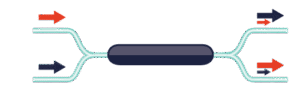
- DWDM combines (multiplexes) many wavelengths onto a single fibre using a multiplexer (MUX) at the transmitter end and separates (demultiplexes) them at the receiver end.
A short history of DWDM
- 1990s – First generation: Early systems offered 4–8 wavelengths at 2.5 Gb/s per channel, used mainly for long-haul telco links.
- 2000s – Dense multiplexing: 40- and 80-channel systems became common, supporting 10 Gb/s per wavelength.
- 2010s – Coherent revolution: Coherent detection and advanced modulation (QPSK, 16QAM) pushed speeds to 100G and beyond.
- 2020s – 400G and 800G era: Software-defined, flexible-grid transponders now fill the same fibre with hundreds of gigabits per wavelength — enabling cloud-scale backbones and 5G transport.
How DWDM works in practice
A typical DWDM link includes several key building blocks that create a transparent optical highway:- Transponders / Muxponders: Convert client signals (Ethernet, OTN) into optical wavelengths suitable for DWDM transport.
- Transponder: one service → one wavelength.
- Muxponder: multiple lower-rate services → one high-rate wavelength.
- Multiplexer / Demultiplexer (MUX/DEMUX): Combines the individual wavelengths onto a single fibre at the transmit end and separates them again at the far end.
- Optical Amplifiers (EDFAs): Boost optical power along long spans without electrical regeneration, extending reach to hundreds of kilometres.
- Optical Add-Drop Multiplexers (OADMs): Allow specific wavelengths to be inserted or removed mid-route without disturbing others.
-
Optical Supervisory Channel (OSC): A low-speed wavelength used for remote management.
Why carriers use DWDM
Massive capacity without new fibre
Each wavelength acts like a new virtual fibre. A 96-channel DWDM system running 400 Gb/s per channel delivers nearly 40 Tb/s over one fibre pair. This makes DWDM the ultimate fibre-multiplier technology.Protocol and service flexibility
DWDM is protocol-agnostic. Ethernet, OTN, SONET, Fibre Channel, and IP/MPLS traffic can coexist on different wavelengths. Carriers can offer dedicated enterprise wavelengths, cloud interconnects, and mobile backhaul on the same infrastructure.Long-distance transmission
With EDFAs (Erbium-Doped Fibre Amplifiers) and Raman amplifiers, DWDM spans can reach hundreds of kilometres between regenerators, drastically reducing cost and latency for national backbones.Scalability and upgrade path
Adding capacity is simple: light another wavelength. Modern “open line systems” let carriers mix vendor optics — scaling from 10G to 800G without new fibre construction.DWDM topologies in carrier networks
- Point-to-point links: Used for dedicated long-haul connections between data centres or POPs.
- Metro rings: OADMs allow selective wavelength drop/add around a ring — ideal for city networks.
- Mesh and ROADM architectures: Modern carriers use Reconfigurable Optical Add-Drop Multiplexers (ROADMs) that can dynamically route wavelengths without manual patching, enabling automatic restoration.
DWDM in real carrier use cases
5G and mobile transport
DWDM enables carriers to consolidate multiple 10G or 25G fronthaul links onto a single fibre pair, guaranteeing latency and synchronisation for eCPRI.Data-centre interconnect (DCI)
Cloud providers use DWDM to connect regional data centres. With coherent optics running 400G per wavelength, operators can flexibly shift capacity where it’s needed most.Metro and regional aggregation
Instead of laying dozens of fibres between city hubs, carriers multiplex diverse services (business Ethernet, 5G, residential broadband) over shared infrastructure.Key technologies enabling modern DWDM
- Coherent detection: Uses amplitude, phase, and polarisation modulation (QPSK, 16QAM) to achieve 100G–800G per channel with better noise tolerance.
- Flexible grid: Allows channel spacing as narrow as 37.5 GHz to optimise spectrum for mixed data rates.
- Software-defined optical networking (SDN): Allows carriers to provision wavelengths programmatically through APIs.
DWDM vs CWDM: a quick comparison
| Feature | CWDM (Coarse WDM) | DWDM (Dense WDM) |
|---|---|---|
| Channel spacing | 20 nm (≈ 2,500 GHz) | 0.4 nm (≈ 50 GHz) |
| Number of channels | Up to 18 | Up to 96+ |
| Reach | ≤ 80 km (no amplifiers) | Up to 1,000 km+ |
| Amplifiers | Not supported | EDFA / Raman compatible |
| Typical speed | 1–10 Gb/s per channel | 10–800 Gb/s per channel |
| Use case | Short metro / access | Metro, regional, long-haul |