






OneAdvisor 800 Wireless
Passive Intermodulation Overview
Passive intermodulation (PIM) has been one of the most common and recurrent problems in cellular networks, particularly in mobile services with a frequency division duplex (FDD) communication mode where PIM signals interfere with mobile transmissions (uplink).
PIM is created when multiple signals, such as when sub-carriers of LTE or 5G radios are transmitted over RF elements with nonlinear characteristics, in which case those signals get mixed into passive components generating intermodulation signals that might be at the same frequency as the uplink channel, which results in interference.

The impact of PIM interference in mobile networks is determined by the sensitivity of the radio in the mobile transmission (uplink) band. The sensitivity level of radios defined by 3GPP are as follows:
| Technology | Cell-site Radio | Sensitivity (dBm) |
| GSM/EDGE (3GPP TS 45.005) |
Normal BTS | -104.0 |
| Pico BTS P1 | -88.0 | |
| CDMA (3GPP2 C.S0010-D) |
Macro Cell (bands 450 and 800) | -117.0 |
| Macro Cell (band 1900) | -119.0 | |
| Pico Cell | -117.0 | |
| WCDMA (3GPP TS 25.104) |
Wide Area BS | -121.0 |
| Medium Range BS | -111.0 | |
| Local Area / Home BS | -107.0 | |
| LTE (3GPP TS 36.104) |
Wide Area BS (5, 10, 15, 20 MHz) | -101.5 |
| Local Area BS (5, 10, 15, 20 MHz) | -93.5 | |
| 5GNR (3GPP TS 38.104) |
Wide Area (5, 10, 15 MHz with SBC of 15 KHz) | -101.7 |
| Wide Area (20 to 50 MHz with SBC of 15 KHz) | -95.3 | |
| Wide Area (20 to 100 MHz with SBC of 30 KHz) | -95.6 | |
| Medium Range (5, 10, 15 MHz with SBC of 15 KHz) | -96.7 | |
| Medium Range (20 to 50 MHz with SBC of 15 KHz) | -90.3 | |
| Medium Range (20 to 100 MHz with SBC of 30 KHz) | -90.6 | |
| Local Area (5, 10, 15 MHz with SBC of 15 KHz) | -93.7 | |
| Local Area (20 to 50 MHz with SBC of 15 KHz) | -87.3 | |
| Local Area (20 to 100 MHz with SBC of 30 KHz) | -87.6 |

PIM signals and Base Station Sensitivity Levels
The adoption of LTE and 5GNR signals with broadband channels are also susceptible to PIM which creates a broadband PIM signature with a distinct slope due to multiple mixing products of sub-carrier signals.

PIM signals and Base Station Sensitivity Levels
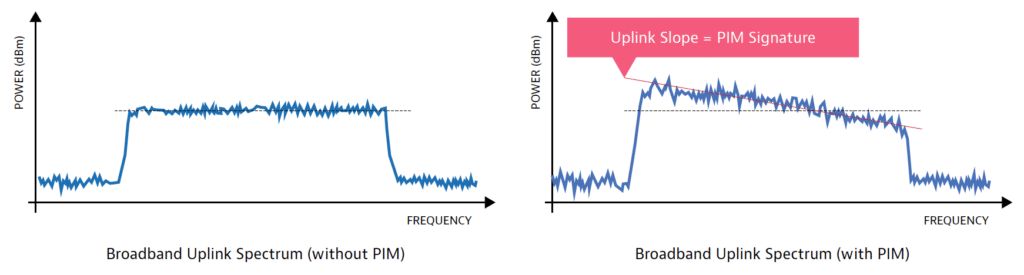
In addition, these new technologies have also incorporated multi-input multi-output (MIMO) technology enabling coverage and capacity with a massive antenna array, but adding more passive components into the cell site creates more possible instances of PIM.
In order to reduce this interference, it is very important to perform strict PIM testing during cell site deployment and maintenance on passive components, including antennas, feedlines, connectors, filters, diplexers, couplers, attenuators, among other; as well as objects in front of antennas, roofing materials, galvanic corrosion, metal snap-in hangers, hose clamps, metal strut fasteners, angle adapters, etc.
PIM Verification
PIM can be tested with VIAVI OneAdvisor 800 which is the ideal portable test solution to verify and troubleshoot 4G and 5G radio access networks for proper deployment and effective operation. The PIM verification process includes two key elements, PIM Detection and PIM Location. It’s process is described as follows:


PIM Detection
There are two main phases and methodologies for PIM detection:

RFoCPRI analysis: provides a realtime spectrum visibility of the uplink channel, via CPRI links, to identify any possible interference.

Realtime Spectrum Analysis (RTSA): provides a realtime persistent spectrum visibility of the uplink over-the-air.
PIM Detection with RFoCPRI
RFoCPRI technology performs RF measurements through the fiber fronthaul which is the link between base band units and remote radio heads.
RFoCPRI verifies the control signals and extracts the RF (IQ) data transmitted between the BBU and RRH at the ground without the need to climb the tower.

In the presence of PIM in the uplink, it is required to perform a PIM Finding to eliminate PIM.
PIM Detection with RFoCPRI
RFoCPRI technology performs RF measurements through the fiber fronthaul which is the link between base band units and remote radio heads.
RFoCPRI verifies the control signals and extracts the RF (IQ) data transmitted between the BBU and RRH at the ground without the need to climb the tower.

In the presence of PIM in the uplink, it is required to perform a PIM Finding to eliminate PIM.
PIM Detection with RTSA
OneAdvisor 800 real-time spectrum analysis (RTSA) can be equipped with a PIM Probe and uplink filters,
and the real-time spectrum can be set with a sound indicator based on a maximum power limit, which will automatically generate a sound and a FAIL indicator in the presence of PIM.
For TDD signals (LTE or 5G) it requires a different measurement technique than conventional spectrum
analysis, since the uplink and downlink signals are transmitted on the same frequency, but in different
timeslots. The OneAdvisor 800 can perform a TDD Auto-Gated Spectrum (TAGS), effectively conducting realtime spectrum measurements triggered only on the flexible symbols, or the timeslots assigned for uplink transmission.
PIM External or Internal
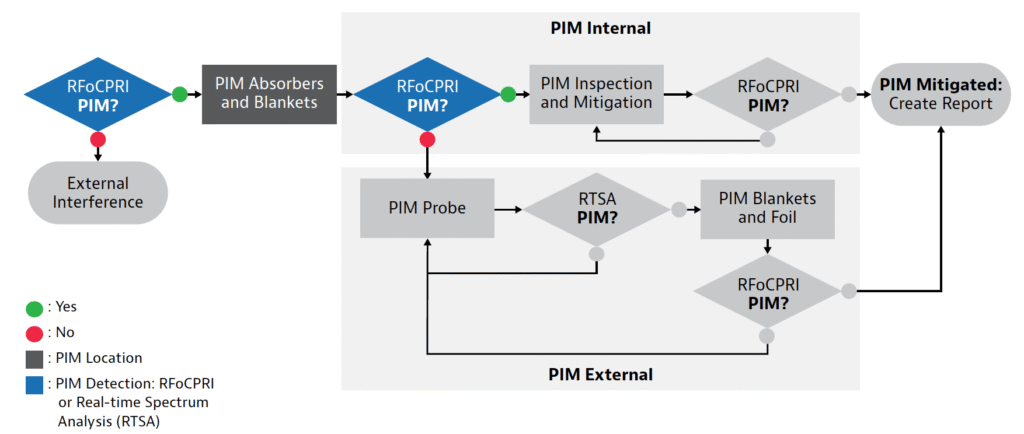
To determine if the PIM source is external (after the cell site antenna) or internal (before the cell site antenna), PIM Absorbers are necessary to conduct a PIM Detection test.
PIM Absorbers are designed to be secured to the front face of base station antennas and suppress forward radiation from the antenna with minimum PIM generation and minimum reflection back into the antenna feed system.

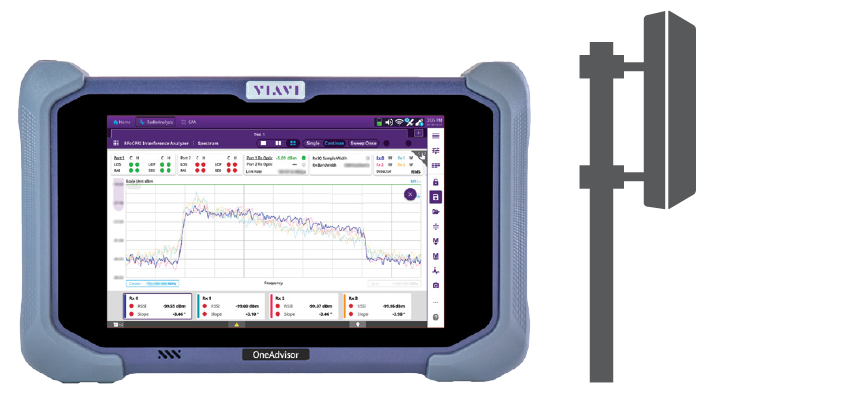
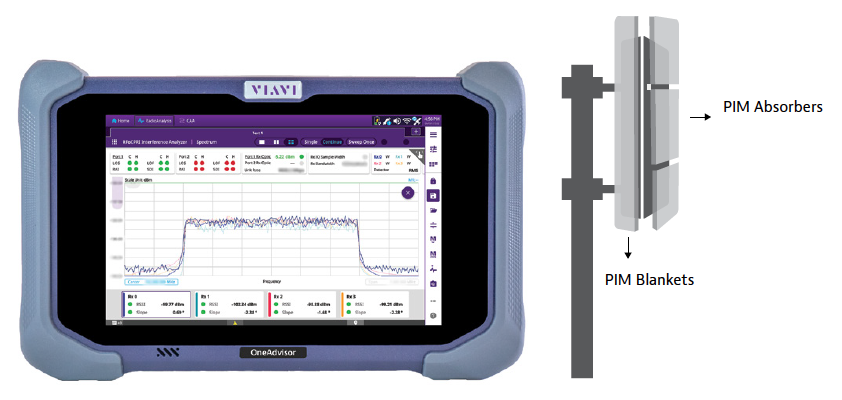
If PIM detection (RFoCPRITM) does not show PIM interference after the PIM Absorbers and PIM Blankets are installed in the antenna then it can be concluded that the PIM source is external (after the antenna). Likewise, if PIM detection (RFoCPRI) still shows the presence of PIM then a PIM source is internal (before the antenna).
PIM Internal

Multiple internal PIM sources might exist in the cell site, for which a PIM inspection is required to assess for any of the following:
- Inspect cables and antennas for possible damage
- Inspect for possible corrosion or rust on RF connectors and mounting structure including metal clamps and support brackets.
- Inspect whether RF connections have been properly tightened, and tap on the feed-line to see if PIM is detected with RFoCPRITM.
PIM External

External PIM can be generated from multiple sources. Therefore, a series of tests using a PIM Probe are required, specifically placing a PIM Blanket and/or a PIM Foil in potential PIM source locations, especially where metal elements lie in close proximity to the radio antenna.
A PIM Probe is used in conjunction with OneAdvisor 800 real-time spectrum to precisely locate external PIM sources in the field.
- PIM Probe frequency range: 600 MHz to 4000 MHz
- OneAdvisor 800 real-time spectrum with RF power level sound indicator
If a PIM source is found, then cover it with a PIM Blanket or PIM Foil and verify it with the PIM Probe and
RFoCPRITM.
PIM Blankets are temporary RF barriers that can be deployed to help isolate sources of PIM. When a PIM Blanket is placed over an external PIM source, PIM from that source is typically reduced by >30 dB.
A PIM Foil is a light weight RF barrier making it easier and faster to cover large areas at rooftop cell sites. A PIM Foil is recommended when wind speeds > 10 mph.
Once PIM locations are identified, mitigation materials can be applied to reduce the PIM levels and improve site performance.


Test Process Automation with Job Manager and StrataSync
VIAVI Test Process Automation allows RF technicians to perform installation and maintenance
tests with confidence:
- In accordance with mobile operator’s test criteria
- Covering all radio types and topologies
- Automatically uploading test results to the StrataSync cloud with simple PASS/FAIL indicator
Job Manager
The VIAVI Job Manager automates test processes, offering mobile network operations and construction teams a self-guided test solution, improving efficiency in the field for radio site installation and maintenance.
Job Manager’s automates the entire process ensuring the proper test sequence is executed according to mobile operator’s requirements, configuration test time is minimized, and results are consistent and consolidated.

StrataSync
VIAVI StrataSync is a cloud-hosted system that provides a centralized management of test solutions including test set management, test configurations, data management, and test results.
StrataSync is designed to eliminate email dispatches, manual test procedures, manual report consolidation, test solution availability and test devices that need calibration.


Ordering Guide

OneAdvisor 800 Bundles
with RFoCPRI and RTSA:
- ONA800A-SPCP
- ONA800A-SPCPCA
- ONA800A-SPCPCAOS
- ONA800A-SPCPCAOS-A
Example: ONA800A-SPCP-CBF
| PIM Accessoriesy | CBF | CBK | CA | CBFA | CBKA |
 PIM Blanket 60 in (1.52 m) 60 in (1.52 m) |
• | • | |||
 PIM Foil 36-Inch x 100-FT Roll |
• | • | |||
 PIM Blanket Kit 3x 120×60, 2x 60×60 |
• | • | |||
 PIM Absorber Kit Case (2) + Front Absorber +Back Absorber |
• | • | • |
References
- ITU-T K.149: Passive intermodulation test methods of array antenna systems in mobile communication systems
- ConcealFab Interference 2022 Product Guide
Download PDF
Click here to download the information on this page as a PDF file.