



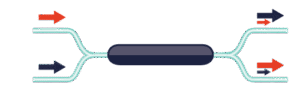

Understanding the Difference Between PON and Point-to-Point Optical Networks
Introduction: The foundation of modern fibre access
Fibre has become the universal transport medium for everything — broadband, mobile backhaul, enterprise connectivity, and cloud interconnects. But not all fibre networks are built the same way. Two major architectures dominate how data is delivered over optical infrastructure:- Passive Optical Network (PON)
- Point-to-Point (P2P) Optical Network
What is a Point-to-Point (P2P) optical network?
In a Point-to-Point (P2P) architecture, each subscriber or endpoint has a dedicated fibre running directly back to a central hub — usually a switch, router, or optical line termination point in the exchange. How it works:- Each user is assigned their own optical fibre from the central office (CO) to their premises.
- The network uses active equipment (transceivers, switches) at both ends.
- All signals are electrically switched or routed at the central site — no optical splitting occurs in the field.
- Bandwidth is not shared — every connection is independent.
What is a Passive Optical Network (PON)?
A Passive Optical Network (PON) is a shared fibre access system that uses optical splitters to connect multiple users to a single fibre coming from the central office. How it works:- One Optical Line Terminal (OLT) in the central office serves many users.
- A Passive Optical Splitter (often 1:32 or 1:64) divides the signal into multiple paths, each leading to an Optical Network Terminal (ONT) at the user’s premises.
- The splitter contains no active electronics — hence “passive”.
- Downstream data is broadcast from the OLT to all ONTs, while upstream transmissions are time-division multiplexed (TDM) to avoid collisions.
Key architectural differences between PON and P2P
| Feature | Point-to-Point (P2P) | Passive Optical Network (PON) |
|---|---|---|
| Fibre topology | Dedicated fibre per user | Shared fibre via passive splitter |
| Equipment in the field | Active switches (optional) | Passive optical splitters only |
| Bandwidth allocation | Dedicated per user | Shared among users |
| Typical use | Enterprise, backhaul, data centres | Residential broadband, FTTH |
| Upstream communication | Independent per user | Time-division multiplexed (TDM) |
| Downstream communication | Direct unicast | Broadcast to all ONTs |
| Power in outside plant | Required (active nodes) | Not required (passive) |
| Operational complexity | Higher (active elements) | Lower (no powered nodes) |
| Scalability (ports) | Limited by fibre count | Limited by splitter ratio |
| Distance limit | Typically ≤ 10–40 km | Typically ≤ 20 km |
| Typical standards | Ethernet, CWDM / DWDM | GPON, XG-PON, XGS-PON, NG-PON2 |
Advantages of Point-to-Point (P2P) networks
1. Dedicated bandwidth and symmetrical performance
Each user gets their own fibre and full link capacity — no sharing, no contention. A 1 Gbps P2P connection really means 1 Gbps up and 1 Gbps down, all the time. This makes P2P ideal for:- Enterprise-grade SLAs
- Low-latency applications (financial trading, cloud interconnects)
- High upload demand (content creation, data backup)
2. Simple troubleshooting and maintenance
Because every fibre is independent, a fault affects only one customer. Technicians can isolate and repair issues easily with tools like OTDRs — each link is distinct. This structure also simplifies network segmentation, allowing upgrades or maintenance on one circuit without impacting others.3. Technology flexibility and futureproofing
Each dedicated fibre can be equipped with any transceiver technology — from 1G to 100G and beyond. Operators can mix wavelengths (using CWDM or DWDM) and support diverse services (Ethernet, Fibre Channel, OTN) over the same infrastructure. P2P is therefore futureproof — bandwidth upgrades require only equipment changes, not redesign of the fibre plant.Disadvantages of Point-to-Point networks
High fibre consumption
Because every user has their own fibre, large-scale P2P deployments require massive fibre counts. For FTTH covering thousands of homes, this quickly becomes impractical — ducts, patch panels, and trays fill up fast.Higher capital and operational cost
More fibres mean more ports, splices, and connectors — increasing both build costs (CAPEX) and maintenance costs (OPEX). Active aggregation switches in the field also require power, cooling, and monitoring, which adds ongoing expense.Limited suitability for mass residential deployment
P2P is efficient for high-value, low-density customers (like enterprises or data centres), but uneconomical for mass FTTH rollouts where each user might pay £30–£50 per month. The ROI simply doesn’t balance the per-user infrastructure cost.Advantages of Passive Optical Networks (PON)
Fibre efficiency and lower infrastructure cost
Because one feeder fibre from the OLT is shared by many customers through a splitter, PON dramatically reduces fibre count and equipment requirements. A 1:32 split ratio cuts fibre demand by 32x compared to P2P. This translates into:- Smaller ducts and enclosures
- Lower port count at the central office
- Reduced CAPEX for build and materials
No power or active elements in the field
The “passive” nature of PON means no powered nodes outside the exchange — just optical splitters. That delivers several advantages:- Lower maintenance and energy costs
- Higher reliability (no field electronics to fail)
- Easier to deploy in rural or hard-to-reach areas
Centralised bandwidth management
Modern PON systems (like XGS-PON or NG-PON2) use sophisticated dynamic bandwidth allocation (DBA) algorithms to share capacity intelligently. Operators can prioritise bandwidth dynamically:- Reserve minimum guaranteed rates
- Allocate burst capacity when the network is quiet
- Balance upstream and downstream demand
Disadvantages of Passive Optical Networks
Shared bandwidth and potential contention
PONs divide total capacity among multiple users. If the shared fibre provides 10 Gbps and serves 32 users, each may see reduced throughput during busy times. Although DBA mitigates this, performance can still vary with user demand — making it less suitable for strict SLAs.More complex troubleshooting
Because the fibre is shared, isolating faults can be more complex. Technicians must interpret composite OTDR traces through splitters, which can obscure reflections and events. Specialised tools — such as PON-optimised OTDRs or VIAVI SmartOTDR with PON filtering — are often required. Faults may affect multiple customers simultaneously, increasing repair urgency.Upgrade complexity
Upgrading from GPON to XGS-PON or NG-PON2 involves:- Replacing OLT line cards
- Ensuring ONTs at customer premises are compatible
- Possibly rebalancing splitter ratios or wavelength plans
Where each architecture fits best
| Application | Preferred Architecture | Rationale |
|---|---|---|
| Residential FTTH | PON | Cost-effective, high-density, passive simplicity |
| Business Services | P2P | Dedicated bandwidth and SLAs |
| 5G Mobile Backhaul | P2P or Hybrid PON | Low latency, high capacity |
| Campus / MDU Networks | PON | Shared fibre infrastructure reduces cabling |
| Data Centre Interconnects (DCI) | P2P | Point-to-point, high-capacity private links |
| Rural Broadband | PON | Minimal field power, low OPEX |
| Critical Transport or Utility Networks | P2P | Deterministic performance and isolation |
Modern hybrid approaches
Many operators are now deploying hybrid architectures that combine the best of both worlds. Example 1: PON for access, P2P for aggregation In FTTH networks, the access layer uses PON for cost efficiency, while feeder fibres between OLTs and core switches use P2P for performance and flexibility. Example 2: WDM-PON (Wavelength-Division Multiplexed PON) WDM-PON is an emerging technology that uses a separate wavelength per user within a shared fibre infrastructure. It blends P2P bandwidth with PON fibre efficiency, though at higher cost and complexity. Example 3: Business overlay on residential PON Some carriers overlay P2P business circuits alongside a mass-market PON using spare fibres in the same duct — reducing build duplication. [Image of WDM-PON network architecture diagram]Key performance comparison
| Metric | Point-to-Point (P2P) | Passive Optical Network (PON) |
|---|---|---|
| Typical downstream rate (per user) | 1–100 Gbps | Shared 2.5–10 Gbps (up to 25 Gbps in 25G PON) |
| Latency | <1 ms (dedicated) | Typically 1–2 ms (shared, TDM-based) |
| Distance range | Up to 40 km | Up to 20 km (depending on split ratio) |
| Power budget | Higher (active elements) | Lower (passive only) |
| Resilience | Isolated faults | Shared segment risk |
| Upgrade path | Change optics | Replace OLT / ONT as standards evolve |
| OPEX | Higher (active maintenance) | Lower (no power in field) |
| CAPEX per user | High | Low |
| Best suited for | Business, enterprise, backhaul | Residential, mass broadband |
Real-world perspective: cost vs capability
Imagine a national operator deploying fibre to 500,000 homes. With P2P, each home would need a dedicated fibre and port — 500,000 fibres and 500,000 OLT ports. With PON (say 1:32 split), that drops to 15,625 feeder fibres and 15,625 ports — a 32x infrastructure reduction. That’s why PON dominates residential and suburban FTTH. However, for a bank, hospital, or 5G tower, that shared structure is unacceptable. They require dedicated bandwidth, deterministic latency, and service separation — all hallmarks of P2P.The evolution of PON: narrowing the performance gap
Modern PON standards are closing the gap with P2P in speed and reliability:| Standard | Downstream / Upstream | Key Feature |
|---|---|---|
| GPON | 2.5 G / 1.25 G | Legacy, widely deployed |
| XG-PON | 10 G / 2.5 G | Higher downstream rates |
| XGS-PON | 10 G / 10 G | Symmetrical, enterprise-capable |
| 25G-PON | 25 G / 25 G | Emerging, 5G-ready |
| NG-PON2 | 40 G / 40 G (4 × 10G wavelengths) | WDM coexistence and resilience |